Daily Life (in the village of Mershina)

The most common question I receive about Bhutan (after “where?”) is a curiosity about how a typical family might live.

Mershina is a village surrounded by beautiful rice paddies and sits below a famous  fertility monastery (more on that later). Their claim to fame is anything in the shape of a penis–for example, an anatomical key chain keepsake.

I resisted the urge and didn’t buy one. Not even the pink one with wings. Although I’m progressing with tongue-in-cheek, infertile couples from around the world come here for the monk’s ceremony and blessing. There’s a book with tales of success inside the temple.

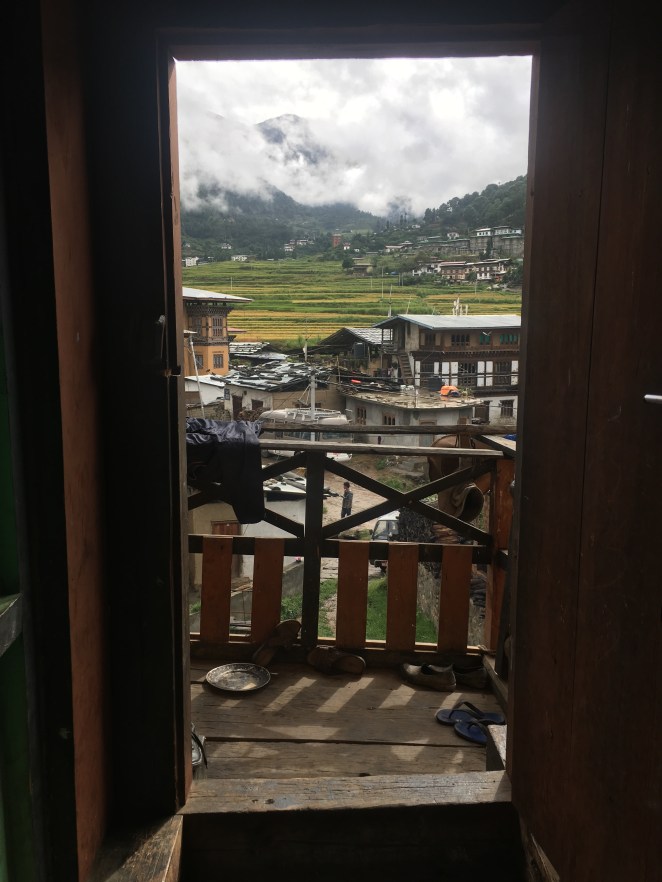
The exterior pictures of the homes in the banner belies what’s inside. We visited a 70 year-old woman who lives with her daughter, her son-in-law and their four children.

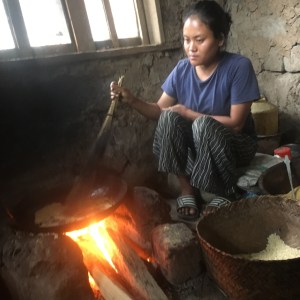
The ground floor is the barn where they keep their water buffalo, goats, and chickens.  The grand-daughter worked in a small shed,  toasting rice they harvested to sell at the market. This treat tastes like Rice Krispies without honey or sugar. IMG_7621

Here’s a juxtaposition: This young lady was home on a college vacation. Her right foot stands in the 21st Century and the left totters in Medieval times. She has no intention of spending a traditional life living in a small farming village.

Climbing steep wood stairs,  we entered the living room. A small color TV was on, images of the Buddhist festival in Thimphu flitted across the screen. The grandmother sat cross-legged on a mat as she invited guests to sit on her new couch. Most homes don’t have such luxurious furniture. She offered us food. Drink. Hospitality. It was an honor that we came to see her.

We proceeded to ask the family questions about life in Bhutan while the grandmother and daughter chewed doma, their lips stained red and teeth blackened by the stimulant in the nut. The grand-daughter on the left side of the photo told us (In English) that she won’t chew and become addicted like her elders.

The grandmother asked us a hard question. “How many hours do you have to ride a bus from here to California in the United States?” We looked at each other stymied, trying to figure out how to explain geographic distance to someone who didn’t know the world. After complex math based upon a 48 mile bus ride to Thimphu taking  3 hours, we came up with an impossible guesstimate of 21 days. Since she’d never seen an airplane, she wouldn’t grasp the concept of traveling across the globe faster.

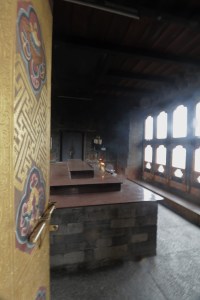
After much laughter, we were invited to tour the house. The left picture above is a Buddhist altar with hanging ceremonial drums and the kitchen is quite modern with a new indoor water spigot and a refrigerator.

But a home is measured by more than “things”. A family and their happiness is something transparent. It’s a moment offered with love. It’s hidden in a smile and shared with faith. Happiness is reaching out across cultural differences and finding the common joyous denominator, even when we are so far apart. IMG_7639

Seeking Nirvana

If faith in your religion brings happiness, then Bhutan has reached nirvana.

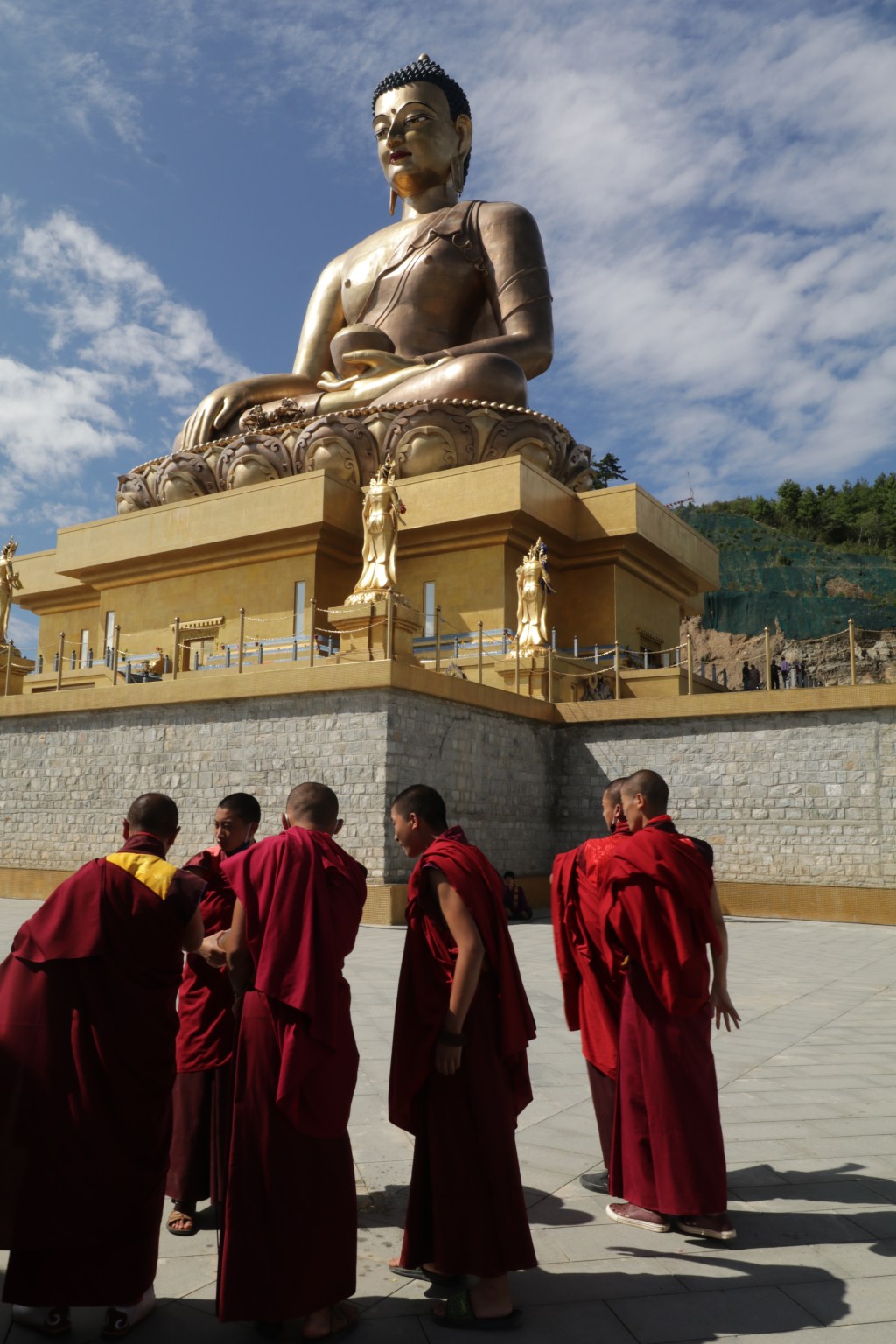
On a high hill overlooking Thimpu, an immense Buddhea, called Puensal Phodrang, glows in the sunlight This multi-storied, 169 foot bronze statue covered in gold is the fullfillment of an ancient prophecy from the year 800 and was commisioned for the  King’s father’s 60th birthday.

This seated Buddha grounds his fingers to the earth signifying the moment He transcended. He also holds a medicine bowl and before him sits the lightning bolt, a vehicle to greater transcendence.

IMG_7434

There is a temple below and inside the ediface containing 125,000 smaller statues of Buddha in infinite lines. In a center alcove, another statue of Buddhea is surrounded by larger-than-life angelic helpers. (In respect, cameras are not allowed inside.)

All of this is impresive, but I was so lucky to visit during a festival with a great Lama leading continuous prayer, 24 hours a day, for over three months. It’s estimated that 10,000 people are present each day (many sleep in temporary tarp tents scattered around the site). Monks circulate through the crowd, passing out donated nourishment.IMG_7431 Under a hanging canopy, more monks sit cross-legged managing stacks of holy manuscripts. IMG_0036
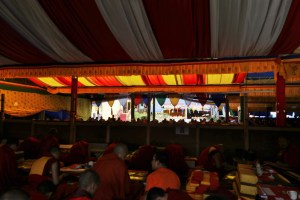
 

Meanwhile, inside the temple below the statue, another group of monks repaired the disentigrating paper in old books while others hand-wrote new pages. A senior priest sat with a computer, I’m guessing he was quality control offering vigilent inspection of each page.

I chuckled as younger monks pulled cell phones out of their red robes and I wondered who sent them a vibrating message. Mom ? Brother ? Lover ? This action was secrative, as a circulating senior admonished those caught slacking off the task.

What impressed me the most was the palpable belief and trust from the thousands of worshippers inside the tent. People of all ages were intent in worship, except for a few young children who amused themselves.

The Thunder Dragon Pursuing Happiness

Bhutan is a cheeky country, promoting the philosophy of Gross National Happiness. They dilligently measure this elusive emotion, standing taller than David preaching to a Golliath world that aquiring material things does not lead to joy.

Since 1971, the King and parliament base their nation’s happiness on spirituality and physical need fullfillment. For survival, humans require protection from the elements, food, and good health. Nothing greater occurs unless these basic needs are met.

Free health care and free education were giant steps in this little Asian land. Bhutan is successful at this, but the United States fails. I’m ashamed of my homeland and the political dung heap we allow to fester.

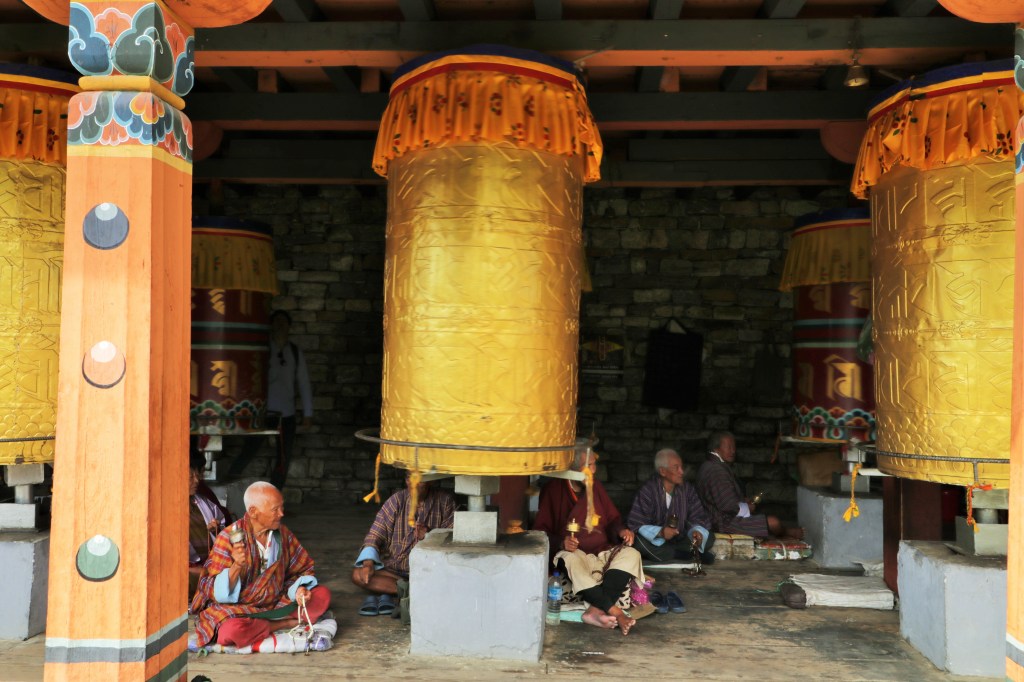
Having spiritual fullfillment is easy when 75% of Bhutan is Bhuddhist.  During my visit I saw people of all ages begining their day at the local Bhuddist Stupa, spinning prayer wheels and fingers slipping over mantra beads. Their faith is strong. Their commitment to compassion for all beings is impressive, rising with a sun hazy with curling incense smoke. Young couples believe in the power of prayer, dropping elderly parents at the temple in the morning. Their post retirement job is to beseach God for compassion IMG_0015and abundance for every life. This is a serious and endless mission. IMG_0020

The King took another leap in 2007 by demanding a parliamentary democracy and he entered his country into the United Nations. Sandwiched like a  rare piece of prime rib between the white rice of China and India, local politics remain a high wire trapeze act without a safety net.

China already took some of the northern proviences and their request to place three highways through Bhutan to access India were quickly denied. An uneasy silence remains. Out of necessity, this tiny country with a big heart dances economically with India. Fear is expressed candidly.

“What will happen if China decides to invade us, as they did in Tibet?” Our guide held no illusions. “Will the United Nations protect us? We don’t think so, because we don’t produce anything great nations need.”  He believed that the majority of adults in Bhutan wouldn’t know the difference living under a communist China.

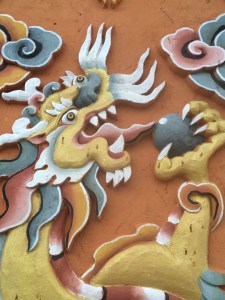
But this land of a dragon licking seven wishing jewelsIMG_7421 is on the cusp of change. Through education of a large young population, Bhutan is entering the twenty-first century with lightning speed. The question is: Can they keep their brightest minds living at home and not escaping abroad for higher paying jobs? 

I really admire the King for addressing this issue as well. I’ve never seen a country so full of pride about their heritage or a greater love for their King and Queen. There is a national dress code for all workers. Men wear a traditional robe called a Gho and women were a dress (Kira) topped by beautiful jackets.

The edict intends to bolster national pride and culture. It’s working. I went to a local festival near the capital city of Thimphu in a downpour of rain that didn’t stop anyone from tromping through the mud and dressing in their finest.


Forced Exodus in Bhutan (Barking Dog Bites)

Every Country slips to the dark side when a leader can’t see how the chess move plays out down the line. Innocent families get killed over misconceived notions.  Violence escalates and the land becomes embattled in civil war.

From 1989-2004, Bhutan entered into a time of terror. With large Nepali and East Indian populations, the Bhutanese feared for survival of cultural and political control.  The King, (k-4, father of the current King) mobilized the army and police for removal of all Nepali and Indian illegal aliens. Many of these supposed squatters were third generation, born in Bhutan, with no other homeland.IMG_0071

Over 80,000 people were rounded up and forced to sign papers stating that they renounced their land. they were warned to leave and to never return. It’s interesting to note that India helped Bhutan at the southern border by grabbing the refugees and plunking them into Nepal. India didn’t want this problem in their country.

Nepal refused to allow the displaced families work visas and the United Nations stepped in to open seven refugee camps.

Back in Bhutan, a dress code was entered into law. Everyone must wear Bhutanese traditional clothing and speak Drukpas. Teaching languages (other than English) in school was eliminated. The King was dilligently removing diversity.

Of course, there was resistance, which turned from peaceful demonstrations to full-out terrorist attacks.  Bombings occurred in the capital, Thimbu. The government retaliated with physical and mental abuse. People disappeared and the mystery remains.  Online I found a list from a refuge camp of 52 names presumed dead, but the real numbers are not known two decades later. Details are buried in time and the land taken isn’t available any longer (per the prime minister).
IMG_0079Flash back to 2003 when the south of Bhutan faced Indian separatist groups who set up heavily armed terrorist camps filled with guerilla soldiers.  Negotiations were attempted, but fell apart. By January 3, 2004 over thirty camps were “eliminated”. Those who live by the sword, truly died by the sword.
World news at the time focused on Afghanistan, Iran and Iraq  where ethnic cleansing rivaled Adolf Hitler.  This allowed King Wangchuck secrecy for a time. But we are all held accountable at the end of the day.

With mounting questions, Father King abdicated at the young age of 50 and placed his 29 year-old son (Jigme Wangchuck) on the throne in 2006. It was a brilliant move to end the discussion. Junior was educated in the United States and England with a firm foundation of democracy and an astute understanding of the political playing field. Luckily, he is adored by his people and respected by other world leaders. Approximately 25% of the population in Bhutan today is of other ethnic groups, but they all must comply with the cultural rules or suffer shunning. They have no identity of their own. IMG_0081

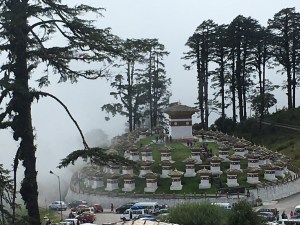
One of the four Mother Queens commissioned 108 Holy Stupas to be built at the top of 10,000 foot Dachula Pass. This number is auspicious, and dedicated to all who died in the conflicts. This often foggy, moody place also has a beautiful temple on the highest spot.

IMG_7665

In the meantime, over 60,000 refugees in the Nepal camps have been relocated to the United States, Britain, Australia, the Netherlands, Norway, Canada, Denmark, and New Zealand. Although there is never a good excuse for force against another, I hope these survivors now face a better life with greater opportunities. I pray for their peace, unending happiness and prosperity.

Outrage over injustice must be aimed at any country doing harm to any ethnic group. When I was in Bhutan the begining of October, the Tibet border was closed by the Chinese as thier removal of native Buddhists continues and incoming Chinese citizens take their land. Refugee camps in Nepal are overflowing.

Back in the United States, President Trump is recommending similar measures that King Wangchuck enacted with removal of  illegal aliens who have children and grandchildren born here. Supremacy and ethnic purity is not what this country teethed on.  I’m hopeful he learns about Bhutan’s lesson, because our population of immigrants–legal or not– have far reaching consequences. A similar event in the US would make Bhutan look like a cake walk.

 Namaste. Let me greet the goodness within you. IMG_7658

Half Moon Island, South Shetlands

This Quark Expedition is sailing back north, heading toward the Drake Passage and Ushuaia, Argentina. This is our last landing for Antarctica. Tomorrow we will be reluctant tourists, leaving this unique, beautiful place.

But for now we will enjoy Half Moon, a 1.2 mile long island  between Livingston  and Greenwich Islands in the South Shetlands.

IMG_3026

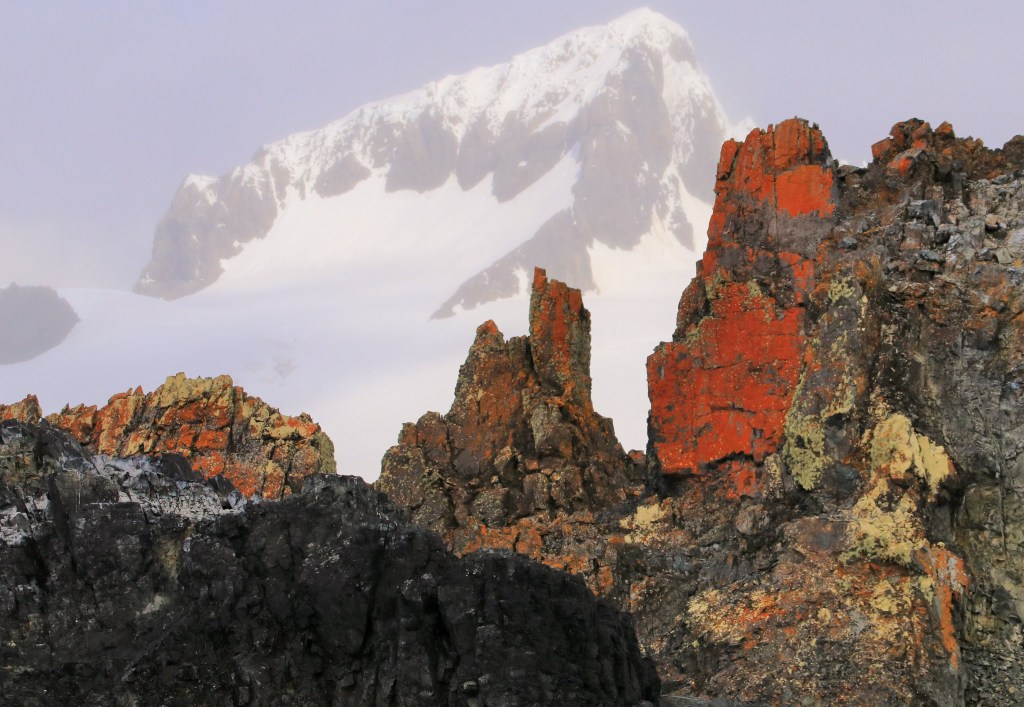
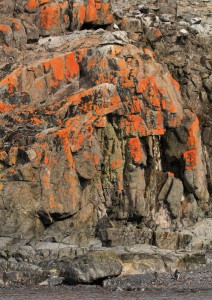
beautiful lichen

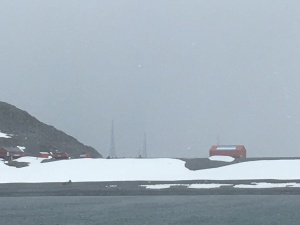
The Argentine Camara station is located at one end

IMG_5683

Argentine Camara Station

and a Chinstrap penguin nesting area at the other.

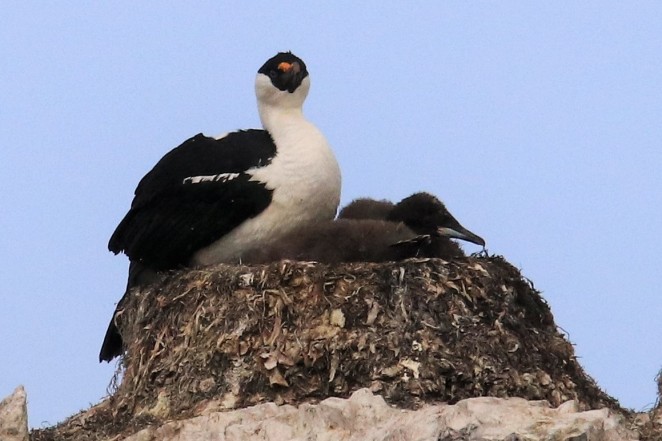
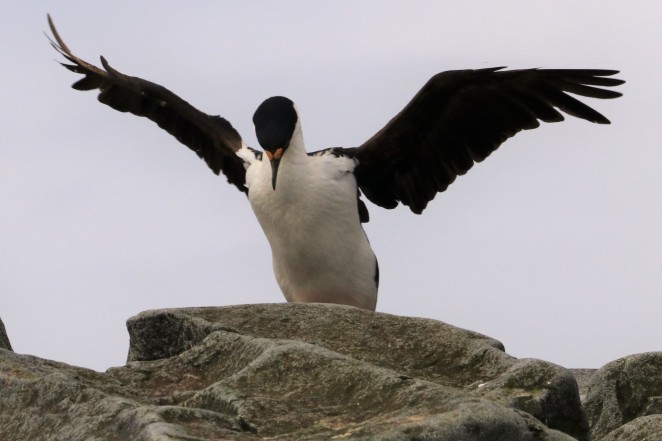
Blue-eyed Shags nest on top of orange lichen pinnacles against glaciated mountains beyond. IMG_3040 (2)

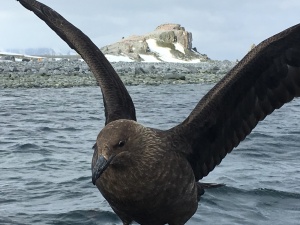
Before landing, we bounced in the zodiacs over choppy waters, checking out seals, shags, and this very cheeky skua who landed right next to me.

IMG_5696

not sure if he wanted to be friends

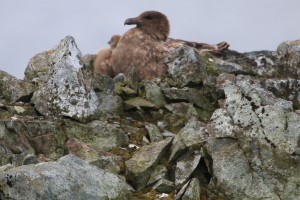
On land, amongst the rocks, broken penguin shells led to a mother skua snuggling with her chick.

IMG_3095

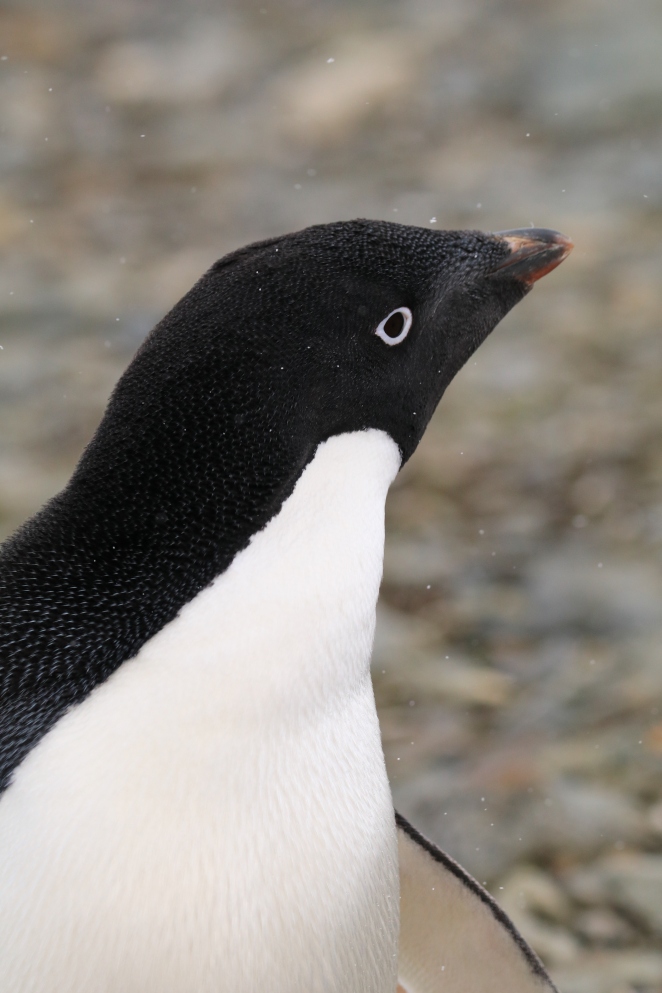
A single Adele penguin approached me with a tilt of the head and a confused look in its eyes. “How do I get back home?” The poor thing was obviously lost, speaking in penguin before wandering off in search of a more appropriate friend. IMG_3104

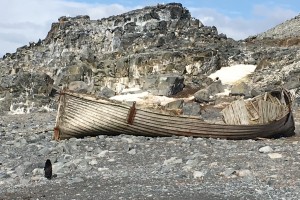
An old whaling craft remains on the beach, another testament of history in this part of the world. IMG_5698

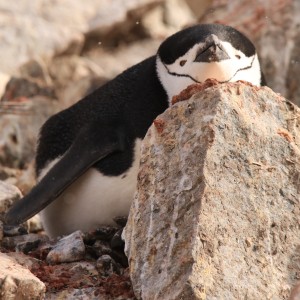
Half Moon Island is the breeding site of approximately 3,300 Chinstrap Penguins. Since this is our last landing, I spent time enjoying their antics and reflecting on all I’ve seen and learned.

I must admit to wiping a tear away, thinking about how much more there is to experience in this vast land.  This little penguin expressed my emotions back at me. IMG_3074

Before I left home, my friends asked strange questions . “WHY do you want to go there?” or “Where is that place….North or South pole?”

I hope my words and pictures have explained the wonders to be found here. More important, I hope I’ve inspired YOU to experience this adventure.

Good-bye from Antarctica.

This leaves a great big question—“Where shall I go next?” —trust me, I have a long list! Stay tuned. IMG_3068 (2)


DECEPTION ISLAND

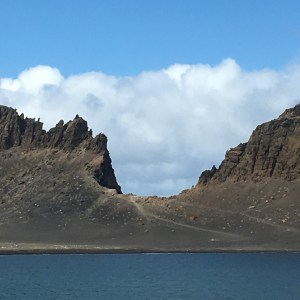
Put yourself on a ship that navigates through a narrow opening called Neptune’s Bellows,

into the sunken caldera of an active volcano. A submerged rock lies about eight feet below the surface, smack-dab in the very middle of the channel. Bite your nails. The current is wild, and a shipwreck lies just inside the entrance as a reminder how quickly life can go bad. Red ash looks like folded curtains along the cliffs and you may see wisps of steam.

This isn’t the opening of a Hollywood thriller, this is  every day drama at Deception Island, in the South Shetland chain.IMG_2965

The sea floor is rising as magma pushes up. and some water temperatures have been recorded at 158 degrees Fahrenheit. During eruptions in the 1960’s the water was so hot, paint melted off of ships.

IMG_5675

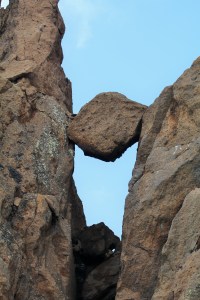
hike up here and you can look down and out a “window” to the sea far below

There are so many cool reasons to experience this closely monitored site. The volcano has changed the micro-climate, allowing over 18 species of moss and lichens not found ANYWHERE else in Antarctica.Check out what it’s like to dive below the surface  with the Lindbald expedition : http://www.deceptionisland.aq/flora.php

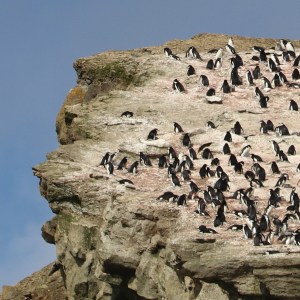
IMG_2994 (3)If you were a bird, would you want to hang out where it’s warm? Of course. The world’s largest chinstrap penguin colony with over 100,000 breeding pairs are here. We also saw blue-eyed shags (cormorants) with juveniles as big as the adults, nesting high above on the cliffs. (Thank goodness for that 600mm lens!)

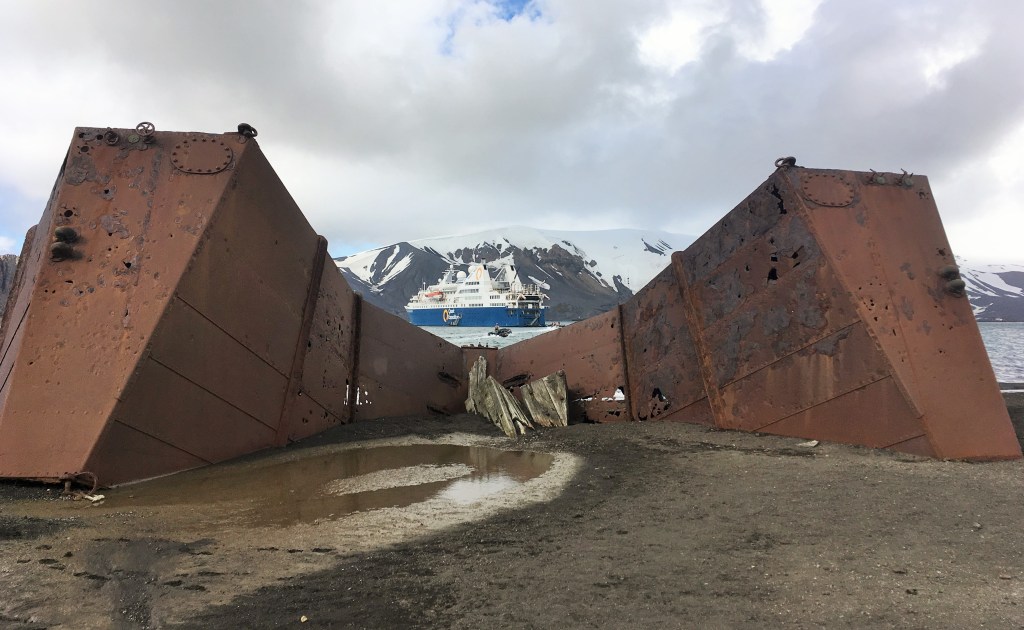
Inside the caldera is the historic site at Whaler’s Bay where ruins of oil tanks, buildings and boats from the early 1900’s sit upon a black ash beach.

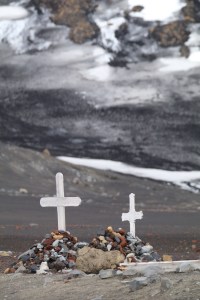
Two lonely graves still haunt me. This used to be the largest cemetery (35 men buried and 10 memorials to presumed drowned) in all of Antarctica before the last eruptions. I cannot let the memory go, knowing they are so far from home. IMG_2926

There’s an airplane hanger at one end. This is where the first trans-Antarctic flights began in 1928. IMG_2895

During and after WWII, the British destroyed some of the whaling remains, and set up a remote military post. There was great concern that the German’s would use Antarctica for nefarious reasons. After the war, the station returned to scientific study until 1967.

On the internet there are pictures of tourists soaking in pools dug into the warm sand. This isn’t allowed anymore (Hello? Environmental impact?) and there’s discussion about reducing the numbers of ships coming here. Count yourself l-u-c-k-y  if you can visit this unique historic and environmental site.

Cierva Cove

Cierva Cove is a serious glacial area on the Western side of Graham Land, up near the top of the Antarctic Peninsula.  Under a  brilliant blue sky, flat-topped tabular icebergs floated in Hughes bay. IMG_5658We zodiac cruised around them, pressing forward into thick brash ice that popped and crackled as air trapped millennia ago released from the melting pieces. Imagine, what animal exhaled that air last, now being freed into the atmosphere again.
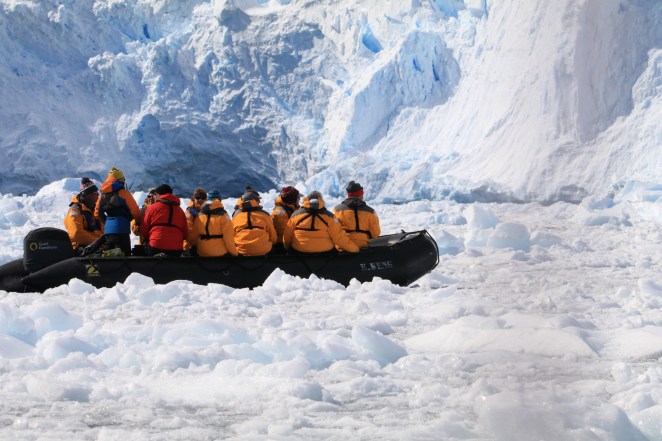
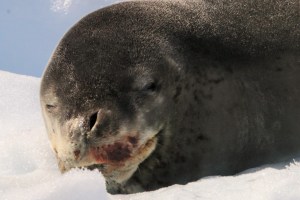
Forging our way, bouncing over and around ice chunks, I easily imagined what it might feel like to get trapped like adventurous explorers a century ago.IMG_2819  Coming around a flat berg, I held my breath passing a sleeping Leopard Seal with a blood-smeared mouth.IMG_2781 With reports of them attacking zodiac boats, I hoped it didn’t decide to wake up and jump at us. Other seals live and breed in colonies. These guys are loners, eating other seals and penguins along with krill and fish. The shape of the head looks rather reptilian rather than the cute seals doing tricks at Sea World.
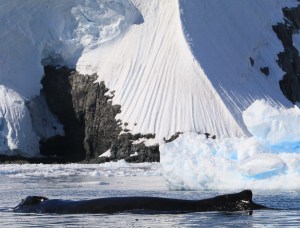
We laughed with delight when a Minke whale surfaced, blowing a geyser of water sky-high. Minke’s are the second smallest of the baleen whales. (S)he stayed around us, feeding for quite a while. A clue this is a Minke is both the blowhole and fin showing at the same time at the water’s edge.IMG_2859

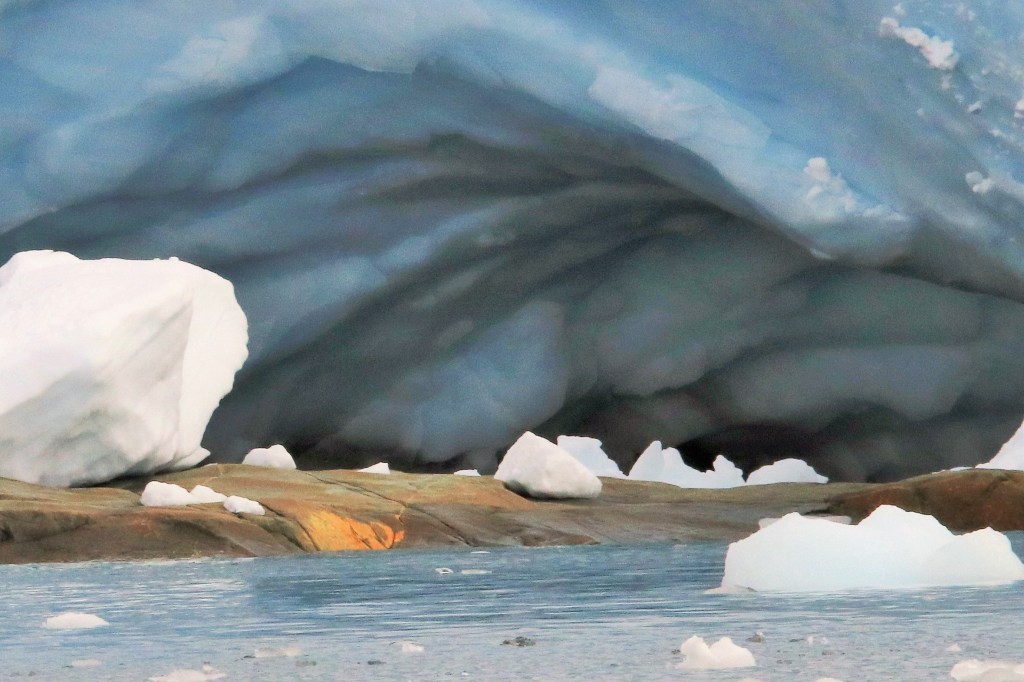
Immense bergs floated around us, caved off nearby glaciers. Ice jumbled in odd shapes while every surface sparkled under the sun.

Weddell seals laid on ice, sunbathing and lazy on this summer day in Antarctica.

Coming around this amazing iceberg, we were surprised by a swimming Leopard Seal. Although this is the third we’d seen on this trip, this was the first in the water, emphasizing such agility and  speed.  I’m glad no one fell in the water.

The last picture is Primavera, the Argentinian summer station. They waved at us, and probably got a kick out of those brave (?) souls who participated in the polar plunge while chinstrap penguins looked on, shaking their heads in disbelief.

D’Hainaut Island

D’Hainaut is an island inside Mikkelsen Harbor on the south coast of Trinity Island. I’m betting this geography notation makes this location of ‘island inside another’ as clear as mud in a swamp.

For clarity, picture the Antarctic Peninsula which looks like a scorpion tail jutting up from the continent. There’s a scattering of islands along the Northwest side called the Palmer Archipelago and Trinity Island is within this chain.

In the era of whale slaughtering, factory ships moored off D’Hainaut and the remains of casks, ribs of boats, and bleached bones are still evident.IMG_5607 This day we chased through the harbor, following a group of Humpback Whales from a safe distance, shooting with our cameras rather than exploding harpoons.

There’s also a deserted Argentine refuge  from the 1950’s, a red hut a vivid highlight amongst snow-packed chinstrap penguin paths crisscrossing the site. The birds wander about, totally ignoring weaner Elephant seals head-banging and roaring.

Chinstrap and Gentoo babies here are much smaller and born later compared to those in the “warmer” north. In late December, chicks on South Georgia are about as big as their parents. Survivability is directly related to the amount of time the egg and chick remain warm before winter strikes again.  Regardless of the southern latitude, D’Hainaut remains an important breeding site.

This zen-like penguin community also ignored our single file conga line of yellow jackets as we carefully avoided their trails, called the ‘penguin highway’ to the sea Komossa512_DSC05890_Highway.

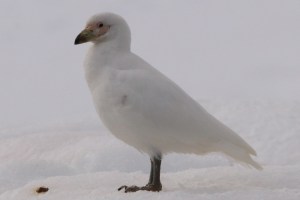
We also saw Snowy Sheathbills (nicknamed “Pattys”)

IMG_2649 sitting on the ice with a meal that looked suspiciously like the remains of a penguin chick. They also steal krill from penguins and are quite the scavengers. This is the only land bird native to Antarctica.

A Weddell seal enjoys a nap and a cute weaner peeks at us.

The last picture is of a Salp and is the most important thing I want you to take away from me today! This is a zooplankton related to jellyfish that form long necklace-like chains that float on the water. They eat phytoplankton and krill–just like everybody else in Antarctic waters.

Up to 200,000 tons of krill are harvested from the open ocean annually, even though the population continues to decrease from climate change. If tiny Krill are reduced, effects will devastate the entire cycle of life. Think about that next time you reach for the box of krill in the pharmacy or health food store. Are polar fish, birds, and mammals being sacrificed? Ultimately, the chain ends with us.

Please. Do not. Buy. Krill. Use another sustainable Omega-3.  

DMG432_wildlife-5

There’s a direct relationship to ocean temperature, krill, and salp populations. When there’s more ice, krill reproduce like mad. When ice melts and water warms, salp numbers increase. This isn’t a good thing, since salps aren’t as nutritious (lower in protein) for higher functioning animals.


Giant Step Onto The Seventh Continent

In my head, I heard the music from 2010 a space odyssey as I finally stepped onto the Antarctic continent.

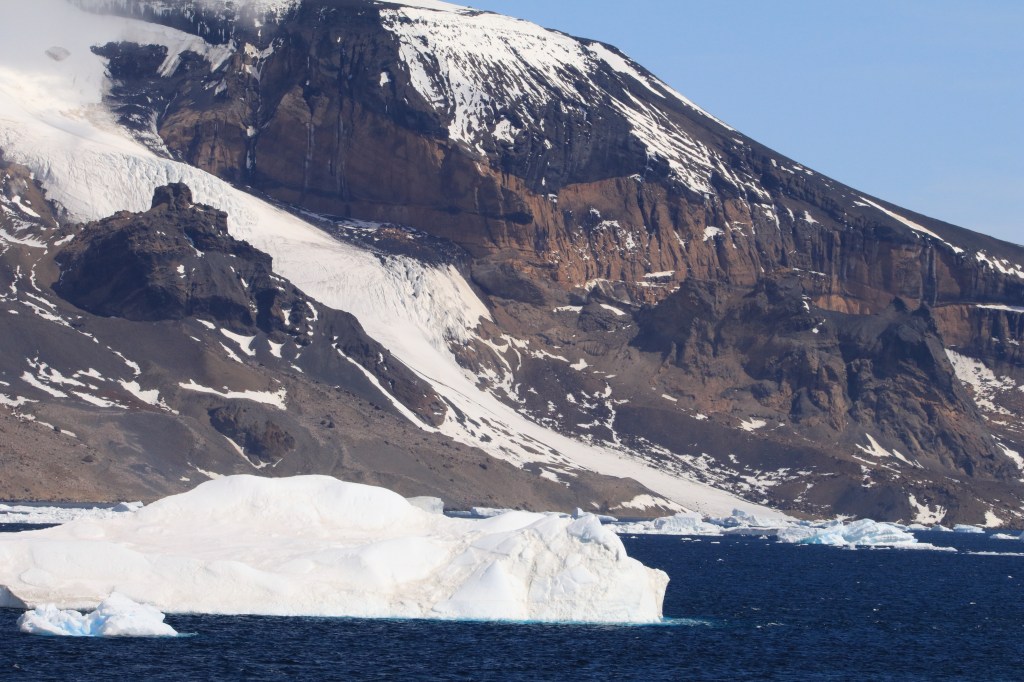
Brown’s Bluff is a tuya on the northeast side of the Tabarin  peninsula jutting out of the top of the Antarctic Continent. ‘Tuya’ is today’s fun word for the day. Here from Wiki is the definition: “a distinctive, flat-topped steep-sided volcano formed when lava erupts through a thick glacier or ice sheet. They are somewhat rare worldwide….” Gracias Wikipedia!

When there’s a glacier, the lava bursting through can’t travel far, building up to form tall cliffs. There are all kinds of yummy volcano things happening here: Basalt, volcanic pillows, and rock bombs standing on the beach like sentinels.

We had a wild zodiac cruise (please don’t ask me to repeat this part of the trip) before landing and climbing up to see a couple of precious snow petrels sitting on nests under a huge boulder.IMG_2515

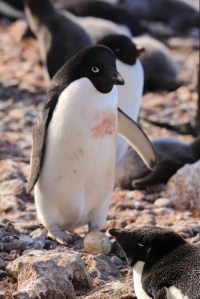
Adele penguins and their babies crowded the lower slope. It’s interesting to see the overall psychology of penguins on each landing. Some groups are fairly quiet with occasional trumpeting and squawking. This crowded beach was one for anger management counselors and perhaps jail. Adult penguins would harass babies with their mothers. Other birds ran around, carelessly pushing and jumping over others. Fights broke out with two or three chasing each other up and down the slopes.

My heart felt sad for one Adele parent. That poor bird tried over, and over again, to pick that big egg up in it’s  small beak. Each time  she tried a rescue attempt, the bloody thing rolled downhill even more. I watched as the adult shifted around, studying the situation, but unable to correct the problem. IMG_2533

Gentoo penguins are also on this beach in large numbers. Big fluffy babies waddled about after their parents, begging for more and more food.

IMG_2476


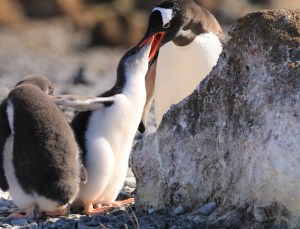
The Adele babies (below left) are just so darn cute but check out weird penguin tongues on the Gentoo!

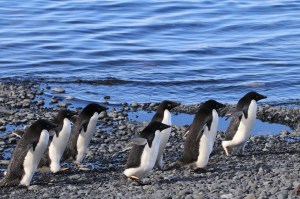
That hook with backward barbs is perfect for snagging slippery krill or other fish. In the meantime, on this active beach, penguins continually march to the sea in groups. IMG_2565

Circling overhead the predators fly silent. Waiting. Watching.

Immense Tabular Icebergs, Kinnes Cove

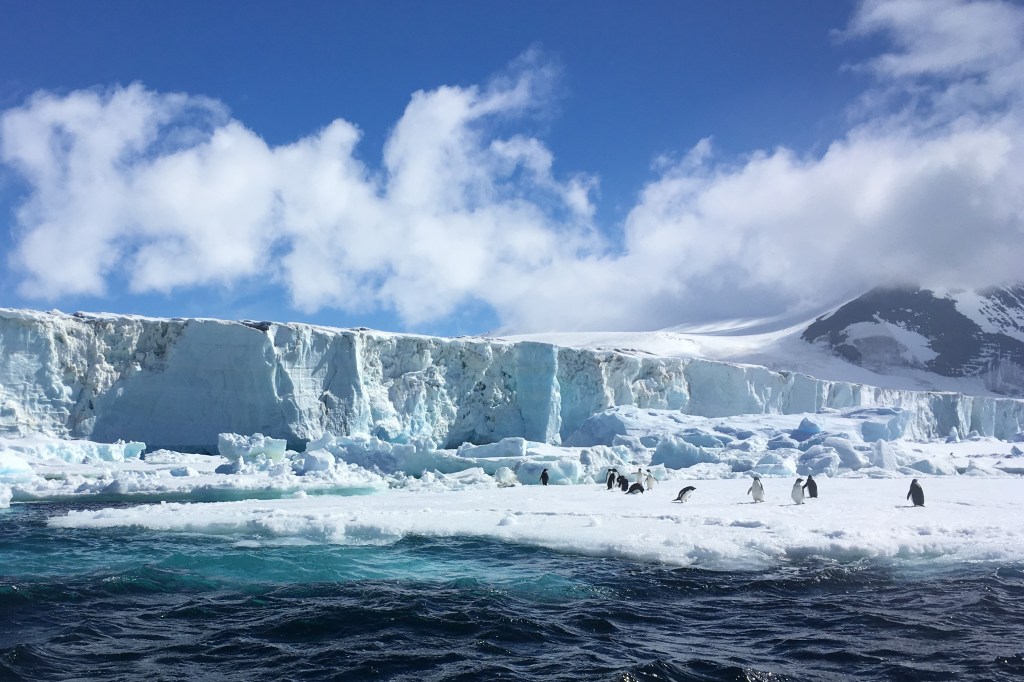
Located on the SW end of Joinville Island, just off the Antarctic Peninsula, Kinnes Cove is named for the owner of an 1892 whaling expedition. Look at the beauty of these icebergs the ship had to carefully navigate through:

Our morning zodiac cruise was an exciting look at masses of blue ice in geometric formations.  Curious Adele penguins gathered on the floes, pausing to watch us as we watched them.

We passed what appears to be a rare albino whale. Not quite Moby Dick, which was a sperm whale, and this guy was traveling fast in the opposite direction of the ship. The albino condition can affect any mammal and a tell-tale sign is pink eyes. Albino Right Whales were filmed off the coast of Chile and South Africa last year, which theoretically isn’t far away from here.  We also saw Crabeater and Weddell Seals napping on the ice.

along a steep hill, penguins climbed as far as the eye could see. Nesting here are Gentoo, Chinstrap and Adele penguins.